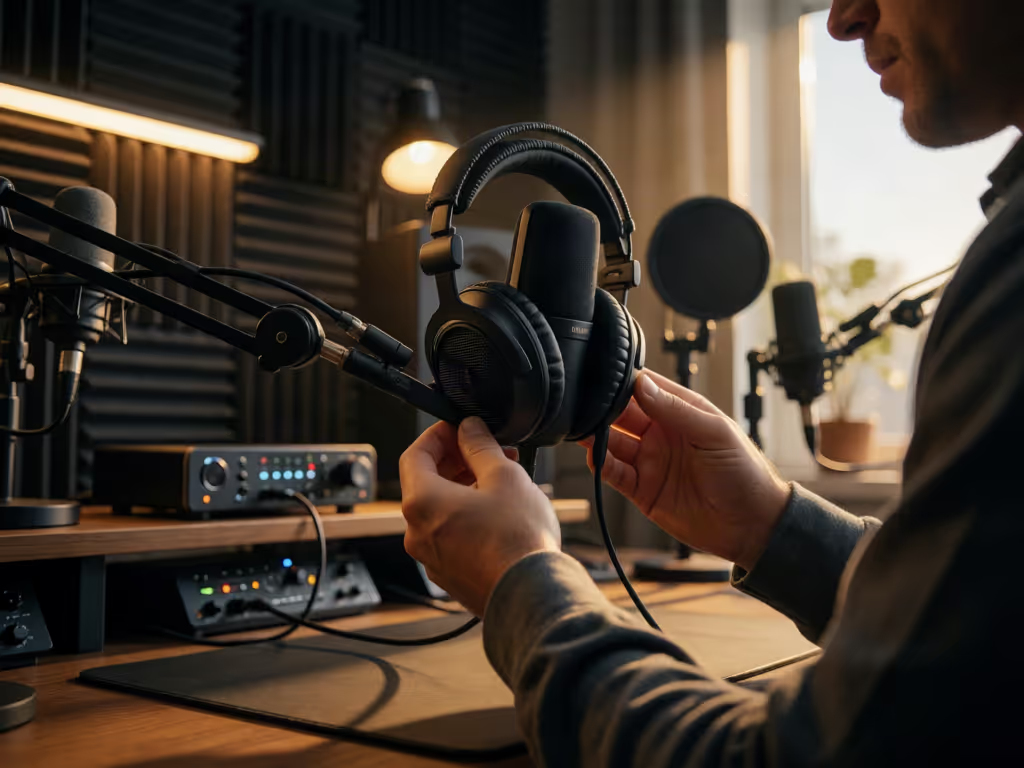
Professional Podcast Microphone for 3D Audio Podcasting
By Nora Adeyemi • 7th Aug
Quick answer
The best professional microphone for a 3D audio podcast depends on the capture format and story, not on a universal ranking. Choose between binaural-style recording and Ambisonics, define the intended headphone stereo render, and test the workflow before recording a full episode.
- Key distinction: The SonicPresence SP15C is a wearable on-ear spatial microphone, while the 3Dio Free Space uses prosthetic human-shaped ears with capsules in the ear canals. The Sennheiser AMBEO VR Mic records four A-format capsule signals that are converted to B-format for its Ambisonic workflow.
- Next step: Record a 60-second scene, confirm channel ordering and normalization, complete any required conversion, render the headphone version, and compare it with the raw capture.
Important: Spatial capture does not guarantee that listeners will feel physically present.
A professional podcast microphone for 3D audio podcasting is not a shortcut to an "immersive" show. It is a choice of capture method and a workflow you can repeat without panic when the record light comes on. If you are already fighting an imperfect room, inconsistent levels, or a setup that needs heroic editing, start smaller: review these room acoustics solutions, decide what spatial audio recording must contribute to the story, then build only the chain required to capture it.
That distinction is freeing. You do not need to buy the internet's favorite microphone or turn every spoken sentence into an effect. You need a clear recording plan, a controlled first session, and a way to check the delivered result on headphones. Small, repeatable wins turn scary red lights into green.
What does "3D audio" mean for a podcast?
For a podcast producer, the useful question is not whether a microphone is labeled "3D." Ask instead: What format will I record, and what will I deliver? The two routes discussed most often are binaural-style capture and Ambisonics, but they are not interchangeable labels for a single sound.
A 3Dio Free Space microphone, for example, is built with two prosthetic, human-shaped ears and microphone capsules inside the ear canals. That physical configuration is a concrete example of a binaural microphone design.
A different route is Ambisonics. In a first-order Ambisonic workflow, the four B-format components are commonly called W, X, Y, and Z. Ambisonic recordings begin as A-format signals and require conversion to B-format. From B-format, a binaural decoder can create a conventional stereo output intended for headphone playback while retaining spatial aspects of the production.
The important beginner takeaway is simple: do not judge the project only by the word "spatial." Write down the format you intend to capture and the format you intend to render. That one note prevents a lot of vague purchasing and setup decisions.
Do I need a special microphone for every part of an immersive podcast sound design?
No single microphone type is established here as the universal best choice for podcasting. Start by separating your show into roles:
- Narration or host dialogue: decide whether the voice needs to remain a conventional, close-recorded element or is part of the spatial scene.
- Locations and atmosphere: decide whether you want to capture the space as it happens or place independently recorded sources during mixing.
- Interviews: decide whether the listener needs a designed spatial presentation, or whether clarity and a stable conversational recording are the priority.
An Ambisonic production can use a dedicated Ambisonic microphone, an Ambisonic microphone matrix, or conventional sources recorded separately and spatialized during mixing. The last option was reported in one production guideline to offer greater sound-source selectivity than the compared capture approaches. That does not make it the right answer for every show; it gives you permission to avoid forcing every source through one capture method.
For an educational show, a practical first experiment might be a short scene transition, a location introduction, or a scripted moment where spatial placement serves the story. Keep the core conversation simple until you can reliably capture and render that smaller segment.
How does an Ambisonic microphone fit into the workflow?
The Sennheiser AMBEO VR Mic is a professional example of an Ambisonic approach: it uses four capsules to produce A-format signals that are converted to B-format.
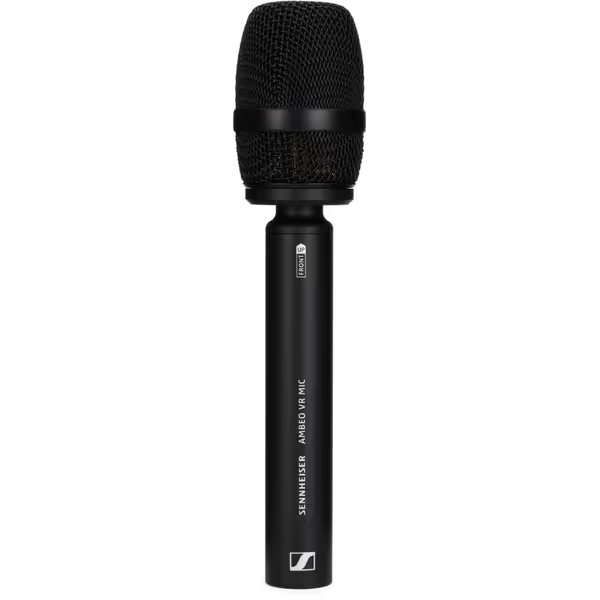
Sennheiser Ambeo VR 3D Microphone
Capture immersive 3D audio for VR with a single point microphone.
$1514
CapsulesFour matched in tetrahedral cluster
CapsulesFour matched in tetrahedral cluster
Pros
Captures spherical, fully spatial Ambisonics audio.
Seamlessly pairs with 360/VR video content creation.
Includes A to B format encoder (VST/AAX).
Cons
Specialized for VR; less versatile for standard podcasting.
Customers praise its sound quality and seamless performance for VR video, deeming it a valuable investment.
Customers praise its sound quality and seamless performance for VR video, deeming it a valuable investment.
That conversion step is not optional housekeeping. It is part of the workflow. The AMBEO VR Mic documentation describes using its A-B Format Converter plug-in for conversion, while broader Ambisonic guidance treats A-format-to-B-format conversion as a required stage before the B-format material is mixed or rendered.
Once you have B-format material, a binaural decoder uses head-related transfer function information to filter the left and right channels separately for stereo headphone playback. The output is still conventional stereo, so the task is not to deliver a mysterious new podcast-file type. The task is to create, check, and export the intended stereo render.
Before you record a full episode, verify these points in a short test session:
- Your recorder can capture the required microphone outputs.
- Your conversion tool is ready for the A-format-to-B-format step.
- Your mixing and rendering tools support B-format.
- Your channel ordering and normalization convention are confirmed before mixing and rendering. Ambisonic guidance distinguishes AmbiX and Furse-Malham conventions, so this is worth putting in your session notes.
- You have rendered a short stereo file and listened on headphones.
This is not glamorous work, but it is the work that turns a promising first capture into a repeatable setup rather than an abandoned folder of unfamiliar files.
Is a binaural headset mic better for a host-led show?
There is no collected basis for a universal ranking between headset/on-ear binaural capture and stand-mounted binaural capture. Treat them as different configurations with different staging possibilities, not as a winner and loser.
For instance, SonicPresence describes its SP15C as a wearable on-ear spatial microphone with left and right microphone placements in front of the wearer's ears. Its manufacturer also describes two matched omnidirectional pickups mounted at the ends of flexible earhooks. The SP15PRO is separately described by the manufacturer as a microphone for recording spatial audio on XLR devices, so understanding the differences in an XLR microphone setup can help you plan the rest of the signal chain.
Those descriptions help you ask a better question: Does this physical configuration suit the scene I am planning? They do not, by themselves, tell you that one configuration will suit every voice, room, or podcast format.
If you are buying for your first project, make the decision with a two-minute test scene on paper:
- Where is the host?
- Where are the other voices or sound sources?
- Is the scene captured as a whole, or assembled from independently recorded sources?
- What is the final headphone stereo render meant to communicate?
If you cannot answer those four questions yet, pause the purchase. Your next useful move is story planning, not more specification comparisons.
What mic technique still matters in a spatial project?
Technique is not an outdated concern just because the production is more ambitious. For any close-recorded spoken segment in your show, make the setup rules visible and repeatable.
Use a simple host checklist
- Choose and document the room choice for each recurring recording situation.
- Put the pop filter in place before the host sits down.
- Set a fist-width distance as the starting mark for a close voice microphone, then Lock your distance for the take using these microphone positioning techniques.
- Set the gain knob during a short rehearsal that includes normal speaking and an enthusiastic line, following a consistent podcast mic gain-staging process.
- If the equipment offers direct monitoring, use it during the rehearsal to make the monitoring decision before the real take.
- Record a brief reference introduction at the start of each session so co-hosts can follow the same procedure.
Call this your zero-post baseline: a short raw recording made before you experiment with processing or ambitious spatial placement. Keep it. When something changes later, you have a human voice and a familiar routine to compare against.
How can I avoid an expensive, confusing first attempt?
Treat the first session as a proof of workflow, not a full production day. Record a short scene. Convert it if you are using an Ambisonic microphone. Render the headphone-oriented stereo version. Listen, write down what happened, and repeat the exact process once.
Do not promise yourself that spatial capture alone will make every listener feel physically present. That is an intended creative goal, not a guaranteed outcome. Before recording, choose a format and, for an AMBEO VR Mic workflow, document its A-format-to-B-format conversion step and channel-order and normalization check.
What should I do next?
This week, create a one-page "3D episode test" sheet. Include the scene purpose, microphone configuration, recording format, conversion step if applicable, channel-order and normalization check, headphone render, and your close-voice checklist.
Then record 60 seconds, not 60 minutes. Preserve the raw capture and the final stereo render side by side. If you can repeat that small test cleanly, you have earned the confidence to plan the next scene (and the next upgrade) from evidence in your own hands.
Related Articles