USB-C Microphone Showdown: MXL AC-404 vs AC-44 vs UB1
By Aarya Menon • 6th Sep
Quick verdict
The MXL AC-44 is the clearest choice if you need explicitly documented USB-C output and a stated 180-degree wide-cardioid pattern.
- Choose the AC-44 if: You want the most complete published specifications, compact size, USB-C, and 24-bit/48 kHz operation. View on Amazon
- Choose the alternative if: The AC-404’s advertised three-capsule, 180-degree pickup description fits your requirements and USB connectivity is enough. The UB1 is documented with both omni-directional and half-omni terminology in Samson’s materials.
- Main trade-off: The published pattern descriptions differ, but the UB1’s conflicting terminology does not support an exact coverage comparison with MXL’s 180-degree specifications. None of these models has a verified head-to-head sound or noise advantage.
Important: The AC-404 and UB1 are documented as USB microphones, but their connector types are not established here. Test the microphone in your actual room before relying on pickup-range or clarity claims.
A USB-C microphone is not automatically the right answer for a cleaner podcast recording setup, especially when the microphone sits on the same desk that reflects voices, carries keyboard vibration, and receives room noise. In this MXL AC-404 vs AC-44 comparison, plus the Samson UB1 boundary mic, the decisive published differences are connectivity and pickup descriptions: MXL specifies a 180-degree wide-cardioid pattern for the AC-44, the AC-404 listing advertises 180-degree pickup, and Samson uses conflicting omni-directional and half-omni terminology for the UB1.
One correction before we start: this is not a three-way USB-C connector showdown. The MXL AC-44 is the only model here explicitly specified with a USB-C podcast microphone output. The AC-404 and UB1 are documented as USB microphones, but the available specifications do not establish USB-C connectors for either.
More importantly, none of the available material includes controlled, level-matched recordings, comparable off-axis plots, or independent self-noise measurements for these exact three microphones. That limits this to a specification-led decision, not a verdict on which one "sounds best." Level-matched samples in real rooms tell the whole story.
The short answer
Choose by connection requirement and the published pattern information:
- Choose the MXL AC-44 if you specifically need USB-C output and want a compact tabletop boundary mic with MXL’s stated 180-degree wide-cardioid pattern.
- Consider the MXL AC-404 if its stated three-capsule, 180-degree design suits your requirements and USB connectivity is enough. Its advertised 25-foot pickup and speech intelligibility are seller claims, not independently verified performance results.
- Consider the Samson UB1 if its published omni-directional/half-omni terminology and intended-use description fit your needs. Samson describes its boundary pickup both as omni-directional and half-omni, so do not translate its terminology into an exact angle against MXL's 180-degree specifications.
Neutral beats flashy in untreated rooms: direct sound and sensible placement matter more than an ambitious spec-sheet interpretation.
First, decide whether a tabletop boundary mic fits your show
All three choices are boundary microphones intended for conferencing-style use; the AC-404 and UB1 are explicitly described as surface-mount models. The AC-44 is described as a USB boundary microphone. These published type descriptions distinguish them from conventional close-miked setups, but they do not establish how any of the three will perform in a particular room.
For a solo host trying to reduce fan noise, room reflections, and desk sounds, no published comparison here proves that one of these models will solve the problem. Microphone polar patterns are the useful starting point, not a guarantee. MXL specifies the AC-44 as 180-degree wide cardioid, while the AC-404 listing advertises 180-degree pickup. Samson’s UB1 materials use both omni-directional and half-omni terminology, so its description should not be treated as an exact counterpart to MXL’s stated 180-degree specifications.
That distinction is more actionable than assuming a newer conversion format will make an untreated office quiet. For more context, learn how room acoustics affect podcast microphones before assuming a new microphone can overcome reflections and background noise.
Before buying, sketch the actual session:
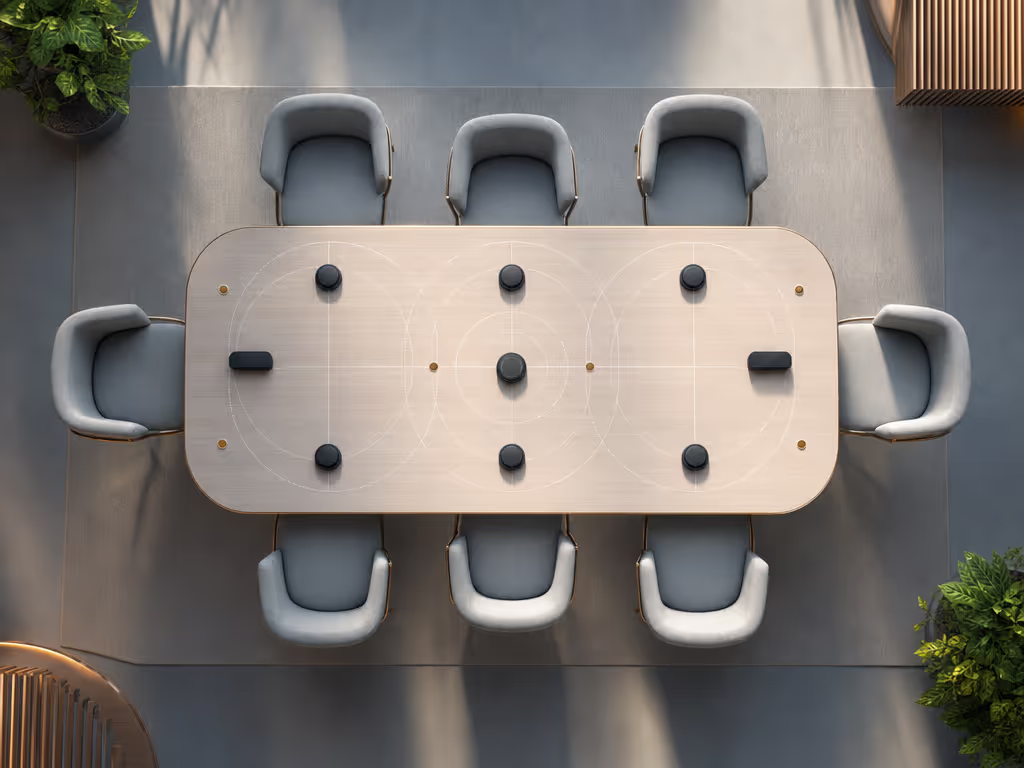
- Where do people sit? Note where the microphone would be placed and compare that layout with each product’s published pickup description.
- Where is the computer or HVAC noise? Identify the loudest sources before testing any microphone.
- Will the desk be touched? These are tabletop devices, so do not assume handling and surface noise are irrelevant just because the enclosure is low-profile. A stable stand or mount can also reduce vibration transfer, so compare microphone mounting solutions alongside the microphone itself.
- Do you require USB-C at the microphone itself? Of these three, only the AC-44 is explicitly documented that way.
MXL AC-44: the only explicitly USB-C option
The MXL AC-44 is a compact USB-C boundary microphone with three capsules and a stated 180-degree wide-cardioid polar pattern. MXL specifies 24-bit/48 kHz operation, a 30 Hz-20 kHz frequency response, a 91 dB signal-to-noise ratio, and dimensions of 3 × 2.5 × 1 inches. It also specifies a 3.5 mm line-level direct feed alongside the USB Type-C output.
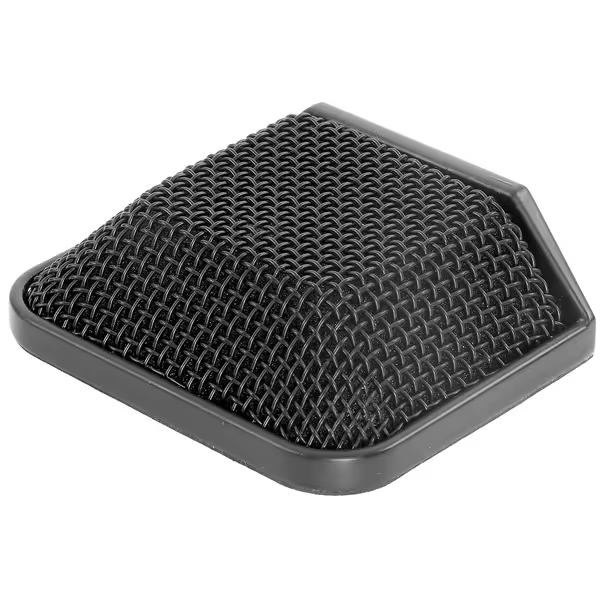
MXL AC-44 USB Boundary Microphone
Captures clear direct sound, minimizes room noise for optimal audio.
$54.95
0Capsule DesignThree-capsule Boundary
Capsule DesignThree-capsule Boundary
Pros
Reduces room echo and background noise effectively.
Flexible placement with wide pickup arc.
Plug-and-play USB-C for all devices.
Low-profile, durable all-metal design.
Cons
No USB-C to C cable included.
For creators shopping specifically for a microphone for USB workflows with a Type-C connection, that connector distinction is real, not cosmetic. MXL also advertises plug-and-play use on Mac and PC. The compact footprint may suit an on-camera educational setup where a large microphone would block the presenter.
What the AC-44's pattern means in practice
MXL specifies the AC-44’s three-capsule array as a 180-degree wide-cardioid design. MXL publishes a 25-foot pickup range, but gives no test conditions or validated speaker-count limit. Do not turn that range into a promise that distant guests will match a nearby host in level, tone, or intelligibility.
MXL says the three-capsule array enhances direct sound while mitigating noise and echoes, and says the pattern eliminates unwanted rear noise. Those are manufacturer claims, not controlled findings. They indicate the intended use case; they do not establish how well the mic will reject a mechanical keyboard, a loud fan, or a reflective wall in your room.
The noise-floor claim needs restraint
MXL describes the AC-44 as the newer, improved version of the AC-404 and says its 24-bit conversion chip yields a lower noise floor and flatter frequency response. That may be relevant if you are choosing between the two MXL models. But there is no published AC-404 noise-floor value in the material here, no shared test method, and no independent A/B recording. The sensible conclusion is simply that MXL positions the AC-44 as the updated model - not that an independently proven noise-floor gap exists.
MXL AC-404: similar stated coverage, fewer verified details
The MXL AC-404 is described in its exact retail listing as a three-capsule surface-mount boundary microphone with an advertised 180-degree pickup pattern and 25-foot range. The same listing gives a 40 Hz-16 kHz frequency response and describes plug-and-play use with Mac and PC computers.
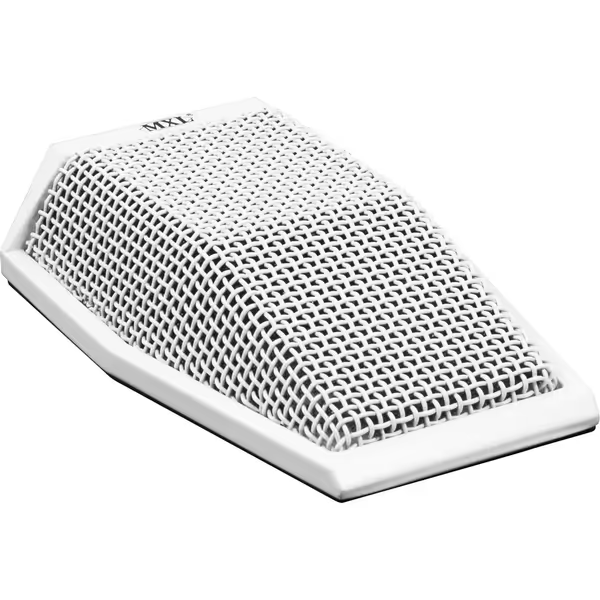
MXL AC-404 USB Conferencing Mic
Clear, wide-angle audio pickup for group podcasts and virtual meetings.
$59.95
Pickup Range25' in 180° arc
Pickup Range25' in 180° arc
Pros
Captures multiple speakers clearly across a room.
Simple plug-and-play USB for instant setup.
Low-profile, durable design for discreet placement.
Cons
LED light cannot be turned off.
Customers praise its clear sound quality and effectiveness for conferences, podcasts, and virtual teaching, offering good value.
Customers praise its clear sound quality and effectiveness for conferences, podcasts, and virtual teaching, offering good value.
Both MXL product descriptions publish 180-degree pickup information, although the AC-44 is specified as wide cardioid and the AC-404 description is seller-provided. The listing also says it is designed for clear speech intelligibility in web conferencing. Treat both that phrase and the 25-foot figure as seller-provided claims, not lab results.
AC-404 vs AC-44: what can actually be concluded
| Decision point | MXL AC-44 | MXL AC-404 |
|---|---|---|
| Documented connector | USB Type-C output | USB product; connector type not established here |
| Published pickup description | Three capsules, 180-degree wide cardioid | Three capsules, advertised 180-degree pickup |
| Published digital format | 24-bit/48 kHz | Not established by the available base-model material |
| Published frequency response | 30 Hz-20 kHz | 40 Hz-16 kHz listing specification |
| Noise comparison | MXL claims lower noise floor than AC-404 | No comparable published noise-floor figure available |
The AC-44 has more complete, manufacturer-published technical information and explicit Type-C output. That makes it the lower-ambiguity pick if your requirement is a small USB-C boundary microphone with MXL’s stated wide-cardioid pattern. It does not prove it will sound better on your voice, at your table, with zero-post processing.
Samson UB1: published pattern terminology needs caution
The Samson UB1 boundary mic is a surface-mount USB condenser microphone intended for settings such as conference rooms, classrooms, courtrooms, and houses of worship. Samson's product sheet calls it omni-directional in its general description and half-omni in its architectural specification. It supplies a 10-foot USB cable and is described as a class-compliant, plug-and-play device for Mac and PC recording software.
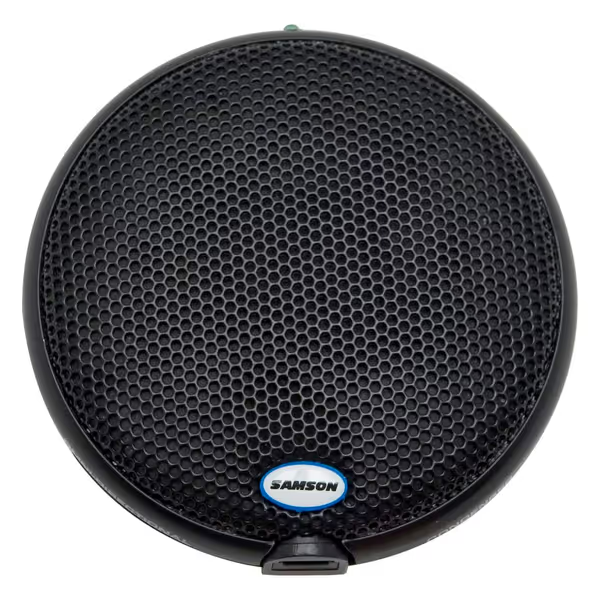
SAMSON UB1 USB Boundary Microphone
Effortless, clear audio capture for meetings and podcasts, no setup fuss.
$99.97
ConnectivityUSB Plug-and-Play
ConnectivityUSB Plug-and-Play
Pros
Instant setup on Mac/PC for quick recording.
Low-profile design is discreet on-camera or tabletop.
Omni-directional captures all voices in a room.
Cons
Lower sensitivity may require careful input level management.
Customers praise its sensitivity, clarity, and ease of use for teleconferencing and recording in various settings. Some users note that the sensitivity is lower than desired, requiring attention to input levels.
Customers praise its sensitivity, clarity, and ease of use for teleconferencing and recording in various settings. Some users note that the sensitivity is lower than desired, requiring attention to input levels.
That mixed omni/half-omni terminology should make you cautious about claims of an exact coverage angle or a direct coverage ranking against the MXL models. Samson’s product sheet identifies conference rooms, classrooms, courtrooms, and houses of worship among its intended environments, but it does not establish a directly comparable coverage result.
Published UB1 specifications
Samson specifies the UB1 at 16-bit resolution with 44.1-48 kHz sample-rate operation, a 30 Hz-18 kHz frequency response, 70 dB signal-to-noise ratio, and 127 dB SPL maximum input level.
Avoid using that 70 dB SNR figure to declare the UB1 noisier than the AC-44's published 91 dB figure. The published methods are not shared, and a signal-to-noise ratio is not automatically a comparable real-room self-noise test. It cannot tell you how a distant participant, a desk fan, or a room reflection will rank across these microphones.
If your biggest issue is a noisy computer in the same room, do not buy the UB1 on the assumption that a higher or lower single specification will rescue the layout.
A repeatable selection and setup check
Pick the mic from your seating map
- USB-C required: AC-44.
- USB connectivity is acceptable: The AC-404 listing advertises three capsules and 180-degree pickup, while its connector type is not established here.
- UB1 under consideration: Treat Samson’s omni-directional and half-omni wording as source language, not as an exact coverage-angle comparison with either MXL model.
Then verify your room before committing
Record a short spoken script with every expected participant seated normally. Use a consistent podcast mic positioning technique during each test so distance and angle do not distort the comparison. Include a realistic pause with the computer and HVAC running. Listen on headphones for three things: whether every voice remains usable, whether off-axis talk becomes distracting, and whether the room's noise floor competes with quiet speech.
Do this before building processing around the microphone. If a raw capture already has uneven voices or constant room distraction, aggressive cleanup can consume time without making the show feel natural.
FAQ
Does USB-C support a microphone?
The AC-44 provides a documented example: MXL specifies USB Type-C output and plug-and-play operation with Mac and PC. That confirms USB-C can be used for this microphone, but it does not establish compatibility for every device-and-cable combination.
Is there a small USB-C microphone in this comparison?
Yes. MXL lists the AC-44 at 3 × 2.5 × 1 inches and specifies it as a USB-C boundary microphone.
The bottom line: buy the pickup pattern, not the promise
For this three-model comparison, the AC-44 is the most clearly documented choice for creators who specifically need a compact USB-C microphone and MXL’s stated 180-degree wide-cardioid pattern. The AC-404 remains a plausible USB alternative with an advertised 180-degree pickup description, but its published detail is thinner. The Samson UB1 is documented as a surface-mount USB boundary microphone with conflicting omni-directional and half-omni terminology, so its coverage should not be treated as directly equivalent to MXL’s stated 180-degree specifications.
Further exploration should be practical: map the seats, identify the loudest off-axis noise source, and make a short raw recording in the actual room. That is the test that turns specifications into a low-regret podcast recording setup.
Related Articles