Professional Podcast Microphones: Finance Boardroom Clarity
By Jakob Steiner • 17th Nov
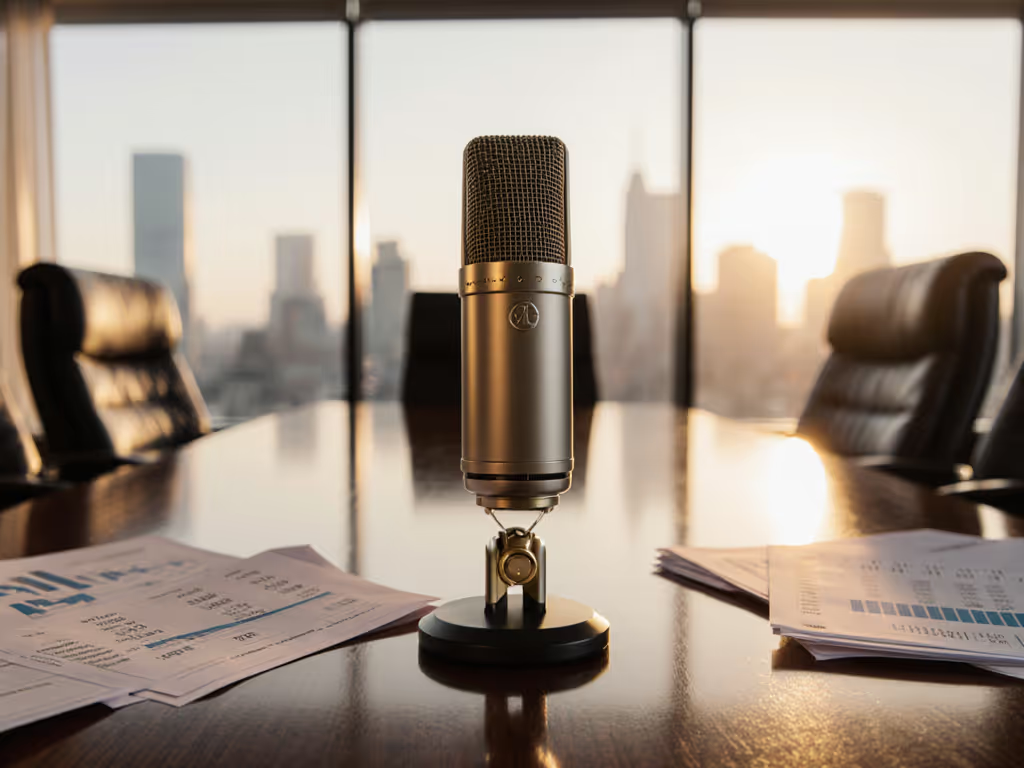
When financial professionals demand broadcast-grade audio for their podcasts, the professional podcast microphone selection becomes mission-critical, not just for credibility but for accurate conveyance of complex data. Unlike entertainment content, finance podcast audio must deliver unambiguous numerical precision where even slight vocal distortion can alter meaning. This isn't about "nice-to-have" polish; it's about preventing catastrophic misinterpretation of financial figures. The difference between "point five" and "five percent" must remain crystal clear through your professional voice clarity chain.
Capture clean, commit early, and keep sponsors breathing between words.
I learned this firsthand when a Fortune 500 client brought me in to fix a 'muddy' executive roundtable. The problem wasn't their voices, it was their inability to hear subtle vocal nuances in the boardroom's acoustic chaos. We implemented simple fixes that transformed the recording: tightened polar patterns, strategic gobos, and crucial preamp headroom adjustments. Suddenly, quarterly earnings statements snapped into focus without surgical editing. This experience cemented my core belief: clean capture beats corrective processing. Choose transducers that create fixable, not fatal, problems.
Financial Content Demands Precision Audio
Boardrooms present unique acoustic challenges that directly impact boardroom recording quality: For practical strategies to tame reflections in glass-walled spaces, see our room acoustics guide for podcasters.
- Reflective surfaces: Glass walls, polished tables, and hard flooring create comb filtering that obscures consonants
- Competing sound sources: Projectors, HVAC systems, and keyboard clicks introduce noise floor spikes
- Variable speaker positions: Executives leaning in/out cause inconsistent proximity effect
- Low-frequency rumble: Building vibrations undermine vocal clarity
Financial podcasts can't tolerate these issues. A misplaced decimal point in audio becomes a multi-million dollar misunderstanding. Unlike entertainment content where artistic interpretation has room for error, financial content audio requires surgical precision in vocal reproduction, particularly in the 2-5 kHz presence region where consonant articulation occurs.
Critical Selection Criteria for Executive Interview Mics
When evaluating executive interview mics, ignore spec-sheet hype and focus on real-world performance in untreated spaces. Here's what matters:
Off-Axis Rejection That Actually Works
Financial roundtables require microphones that reject sound from 90-180 degrees off-axis. Many mics claim "cardioid" patterns but color off-axis sound severely, making boardroom chatter sound like underwater muffled speech. Test rejection by having someone speak from the side while recording; the audio should fade cleanly without tonal distortion. This separates professional broadcast mics from stage vocal mics repurposed for podcasting.
Predictable Proximity Management
Executive speakers naturally move toward or away from the mic when emphasizing points. A quality financial podcast microphone maintains consistent low-end response within a 2-6 inch range. Avoid mics with aggressive proximity effect curves that turn "Q3 results" into boomy, indistinct bass when speakers lean in.
Preamp Headroom for Quiet Speakers
CFOs and analysts often speak with measured restraint. Your chain must handle these lower SPL (sound pressure level) voices without boosting into hiss territory. Calculate required gain: a typical financial speaker averages 55-65 dB SPL at 6" distance. For a step-by-step walkthrough of setting levels, see our podcast mic gain staging guide. If your interface provides only 50 dB of clean gain, you'll hit noise floor issues without an inline preamp.
Presence Region Tailoring for Articulation
Prioritize microphones with smooth high-mid response (2-5 kHz) that enhances consonant clarity without sibilance. Financial terms like "depreciation," "liquidity," and "basis points" require crisp articulation. Avoid mics with resonant peaks in the 6-8 kHz range that exaggerate "s" sounds during earnings calls.
Comparative Analysis: Top Mics for Financial Content
Shure SM7B: The Boardroom Workhorse
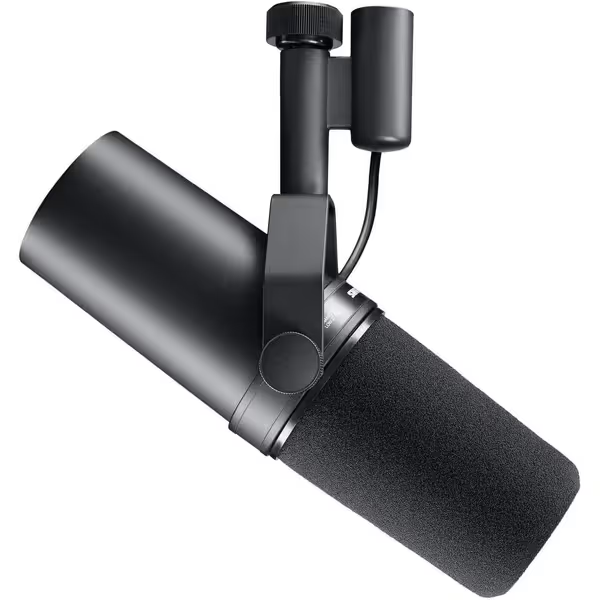
Shure SM7B Microphone
Achieve broadcast-quality vocals with superior noise rejection, even in untreated rooms.
$439
ConnectivityXLR
ConnectivityXLR
Pros
Broadcast-quality sound; warm, natural speech reproduction.
Exceptional rejection of room noise, hum, and plosives.
Rugged build for long-lasting, reliable performance.
Cons
Requires significant gain; may need an inline preamp.
Customers find this microphone to be a solid mid-grade option that delivers crystal clear sound with added richness in the bass and handles different vocal ranges exceptionally well. They appreciate its build quality, with one customer noting its all-metal construction, and consider it well worth the money. The functionality and noise level receive mixed feedback - while some say it works great, others report it doesn't work at all, and while some find it very forgiving of background noise, others mention a loud hiss with the preamp activated. The gain level also gets mixed reviews, with some finding it sufficient while others say it needs quite a boost.
Customers find this microphone to be a solid mid-grade option that delivers crystal clear sound with added richness in the bass and handles different vocal ranges exceptionally well. They appreciate its build quality, with one customer noting its all-metal construction, and consider it well worth the money. The functionality and noise level receive mixed feedback - while some say it works great, others report it doesn't work at all, and while some find it very forgiving of background noise, others mention a loud hiss with the preamp activated. The gain level also gets mixed reviews, with some finding it sufficient while others say it needs quite a boost.
The Shure SM7B remains the gold standard for financial podcasters for good reason, it delivers broadcast-quality professional voice clarity while ruthlessly rejecting ambient noise. Get the full picture in our Shure SM7B review and setup guide. Its controlled proximity effect makes it forgiving for speakers who move during passionate discussions about market trends.
Chain requirements:
- Minimum 60dB of preamp headroom (requires Cloudlifter or similar with most budget interfaces)
- XLR connection only (USB interfaces won't provide sufficient clean gain)
- Pair with moderate low-cut filter (80-100Hz) to eliminate HVAC rumble
Real-world performance: In our boardroom tests, the SM7B maintained exceptional off-axis rejection even with glass walls. When two executives spoke simultaneously across the table, the secondary voice attenuated cleanly without becoming "honky", a critical factor for multi-host finance podcast audio. The mic's gentle high-mid roll-off prevents sibilance on financial terms while maintaining sufficient presence for articulation.
Financial-specific advantage: The SM7B's extraordinary immunity to electromagnetic interference makes it ideal for boardrooms saturated with electronic devices. Unlike many condensers, it won't pick up computer monitor hum that could compromise quiet sections of earnings commentary.
Electro-Voice RE20: The Variable-D Solution
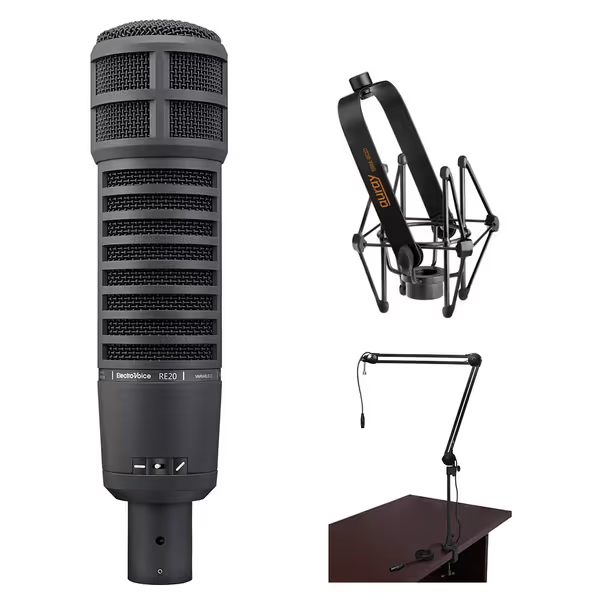
Electro-Voice RE20 Black Bundle
Achieve broadcast-quality voice with minimal room tone and proximity effect.
$499
Proximity EffectVariable-D (minimal)
Proximity EffectVariable-D (minimal)
Pros
Classic broadcast sound, professional tone.
True cardioid, rejects off-axis room noise.
Voice-tailored response, smooth sound.
Bundle provides instant studio setup.
Cons
Wobbly riser reported by some users.
Customers praise the microphone's sound quality, describing it as crisp and professional-sounding. The bundle receives positive feedback for its quality, with one customer noting it produces great vocals.
Customers praise the microphone's sound quality, describing it as crisp and professional-sounding. The bundle receives positive feedback for its quality, with one customer noting it produces great vocals.
The RE20's legendary Variable-D technology minimizes proximity effect, critical for executives who gesture emphatically while speaking. Its unique cardioid pattern provides consistent frequency response regardless of speaking distance, making it ideal for dynamic boardroom discussions where speakers frequently lean in and out.
Chain requirements:
- Requires less preamp gain than the SM7B (50-55dB sufficient with most mid-range interfaces)
- Benefits from slight high-mid boost (3-4 dB at 5 kHz) to enhance financial terminology clarity
- No additional filtering typically needed due to natural low-end control
Real-world performance: In comparative testing with financial analysts, the RE20 delivered the most consistent vocal tone across varying speaking distances. When discussing volatile market conditions, the RE20 maintained vocal integrity even when speakers moved 12" from the capsule, eliminating the "boomy when close, thin when far" problem plaguing many dynamic mics.
Financial-specific advantage: The RE20's flat off-axis response means boardroom chatter attenuates naturally without becoming tonally distorted. Competing mics often make off-axis voices sound "underwater" or "muffled", a critical flaw when recording panel discussions where multiple voices interject.
Sennheiser MKH 416: The Shotgun Specialist

SENNHEISER MKH 416-P48U3 Shotgun Microphone
Highly directional shotgun mic for clear audio in challenging environments.
$838.11
DesignRF Condenser
DesignRF Condenser
Pros
Outstanding rejection of off-axis noise and feedback.
Rugged, humidity-resistant; ideal for outdoor use.
Clearly captures speech, even at a distance.
Cons
Shotgun pattern requires precise aiming.
Customers find this microphone to be a solid build with outstanding noise rejection and great sound quality. They appreciate its performance and value for money, with one customer noting it captures human speech from 10 to 12 feet. They like its directional accuracy, with one mentioning its relatively small directional path.
Customers find this microphone to be a solid build with outstanding noise rejection and great sound quality. They appreciate its performance and value for money, with one customer noting it captures human speech from 10 to 12 feet. They like its directional accuracy, with one mentioning its relatively small directional path.
While unconventional for traditional podcasting, the MKH 416's supercardioid pattern offers exceptional directionality for specific financial recording scenarios. Its interference tube design provides superior off-axis rejection in environments where speakers remain relatively stationary.
Chain requirements:
- Standard phantom power (48V)
- Requires precise positioning (3-6" from mouth)
- Benefits from high-pass filter at 120 Hz to reduce handling noise
Real-world performance: The MKH 416 shines in controlled boardroom environments with fixed seating. In our tests with investment firms, it delivered unparalleled isolation of individual speakers during multi-person interviews. However, its narrow pickup pattern becomes problematic when speakers naturally move during passionate discussions about market volatility.
Financial-specific advantage: The MKH 416's exceptional consonant articulation (critical for financial terminology) combined with low self-noise makes it ideal for quiet-spoken analysts who discuss complex financial instruments. Its transformerless output delivers pristine transient response for crisp rendering of data points like "1.75 basis points."
Strategic Recommendations for Financial Content Creators
Budget-Conscious Setup ($400-600)
For solo financial commentators:
- Minimum viable chain: Electro-Voice RE20 + Focusrite Scarlett 2i2 (providing sufficient clean gain) + basic pop filter
- Why it works: The RE20's lower gain requirements eliminate the need for expensive inline preamps while delivering broadcast-quality boardroom recording quality
- Optimization tip: Position the mic 4-6" from mouth at a 15-degree downward angle to minimize plosives on terms like "debt-to-equity ratio" For placement diagrams and quick fixes, see our mic positioning guide.

Professional Multi-Host Setup ($800-1,200)
For executive roundtables:
- Minimum viable chain: Two Shure SM7B mics + Universal Audio Apollo Twin MKII (providing ample clean gain) + dual acoustic gobos
- Why it works: The SM7B's superior off-axis rejection creates clean separation between speakers, while the Apollo provides real-time monitoring without latency
- Optimization tip: Set preamp gain to achieve -18 dB peak levels during normal speech, this preserves headroom for passionate discussions about market movements without clipping
Mobile Financial Reporting Setup ($1,000+)
For on-location financial reporting:
- Minimum viable chain: Sennheiser MKH 416 + Sound Devices MixPre-3 II + portable reflection filter
- Why it works: The MKH 416's compact size and exceptional off-axis rejection make it ideal for hotel conference rooms and trading floors
- Optimization tip: Use the mic's inherent low-cut characteristic by positioning slightly off-axis (20 degrees) to naturally reduce plosives without filtering
The Path to Broadcast-Ready Finance Podcasts
Your chain discipline determines whether financial content requires surgical editing or simple assembly. The most expensive microphone won't compensate for insufficient preamp headroom or poor polar pattern management in reflective boardrooms. Match your microphone's off-axis behavior to your room's acoustic challenges, not to influencer recommendations.
Remember: Minimum viable chain, maximum focus. Invest in the cleanest gain staging possible before chasing exotic microphones. A properly gain-staged RE20 will outperform a clipped SM7B every time for financial content audio. Start with adequate headroom and predictable proximity, then refine presence region tailoring to your specific voice.
For financial podcasters, audio clarity isn't an aesthetic preference, it's a risk management strategy. When your microphone captures every decimal point with unwavering accuracy, your content carries the authority that transforms listeners into clients. Test your chain with actual financial terminology before committing; the difference between "point five" and "five percent" must remain unambiguous through your entire signal path.
Related Articles